


Why Today’s Vehicle Paint Systems Deteriorate Sooner Than Expected?
UV Exposure, Environmental Stressors, Surface Chemistry, and Manufacturing Realities Explained
Modern cars often leave the factory with stunning visual appeal—mirror-like gloss, rich metallic tones, and smooth, uniform finishes. Yet despite this initial perfection, many vehicles begin to show visible paint deterioration far earlier than owners anticipate. Fading, loss of gloss, clear-coat oxidation, chemical staining, water spotting, cleaning with harsh chemicals like iron removers and etching from bird droppings are now common on vehicles that are only a few years old.
This phenomenon is not the result of poor maintenance or isolated defects. It is a predictable outcome of how modern automotive paint systems are designed, formulated, and exposed to today’s environments. This article examines the issue through the lenses of materials science, surface chemistry, and industrial manufacturing—cutting through marketing claims to explain what is really happening at the molecular and systemic level.
________________________________________
The Fundamental Shift in Automotive Paint Design Philosophy
To understand why paint degradation occurs earlier today, one must first recognize a crucial reality: modern vehicle paint systems are engineered under very different priorities than those used two or three decades ago.
Over time, automotive coatings have been reshaped by several converging pressures:
• Stricter environmental and emissions regulations
• The need for faster, more efficient mass production
• Cost optimization across large manufacturing volumes
• Shorter assumed vehicle ownership cycles
These factors have profoundly altered how paint is formulated, applied, and cured on modern production lines.
________________________________________
Why Modern Car Paint Ages Faster Than Expected
Thinner protective layers
Earlier solvent-based paint systems typically resulted in thicker clear-coat layers. Today’s finishes are deliberately thinner to reduce material usage, accelerate curing, and increase production throughput. While efficient, thinner films provide less material to absorb ultraviolet radiation, chemical exposure, and mechanical wear over time.
Transition to water-based formulations
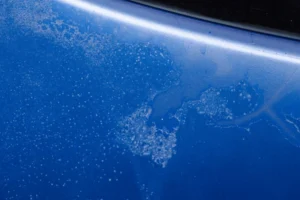 Water-borne clear coats significantly reduce volatile organic compound (VOC) emissions and environmental impact. However, these systems often exhibit different polymer structures, altered cross-linking behavior, and—in many cases—reduced intrinsic resistance to long-term UV exposure unless heavily reinforced.
Shortened durability targets
Modern vehicle finishes are generally engineered to remain visually acceptable for the statistically average ownership period, typically around 8 to 12 years. This does not imply intentional failure, but it does mean that multi-decade cosmetic preservation is no longer the primary design objective.
In many global markets, vehicles are scrapped, exported, or significantly depreciated after roughly a decade, reducing the incentive to engineer paint systems for extremely long aesthetic lifespans.
________________________________________
Environmental Stress Has Intensified
While paint durability margins have narrowed, real-world exposure conditions have become harsher:
• Increased urban air pollution
• Higher average UV indices due to atmospheric changes
• More aggressive automated car wash chemicals
• Widespread acid rain and industrial fallout
• Higher average driving speeds and thermal cycling
The result is a growing mismatch between what factory paint systems can endure and the environments they are expected to survive.
________________________________________
Understanding the Modern Automotive Paint Stack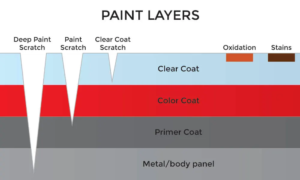
A typical factory paint system consists of multiple functional layers:
• Electrocoat (E-coat): corrosion resistance
• Primer: adhesion and surface leveling
• Base coat: color and visual effects
• Clear coat: gloss, UV defense, and surface protection
Among these layers, the clear coat serves as the primary protective barrier—and over time, it is also the most vulnerable. Yes you can protect your clear coat.
________________________________________
How UV Radiation Gradually Destroys Paint at the Molecular Level
Ultraviolet radiation is the single most dominant long-term degradation factor affecting automotive paint.
Clear coats are polymer networks, commonly based on polyurethane or acrylic-urethane chemistry. Prolonged UV exposure breaks molecular bonds within these polymers, generating free radicals and triggering oxidation reactions. Over time, this leads to:
• Progressive gloss loss
• Surface chalking
• Yellowing or color fading
• Reduced hardness
• Micro-cracking not visible to the naked eye
Once oxidation begins, degradation accelerates. The surface becomes chemically more reactive, allowing contaminants and moisture to penetrate more easily.
Importantly, UV damage is cumulative and irreversible. Washing cannot undo it. Polishing only removes the damaged material—reducing remaining clear-coat thickness and shortening the paint’s remaining lifespan.
________________________________________
Environmental Fallout: Accelerating the Damage
While UV radiation weakens the paint structure, environmental contaminants often deliver the final blow.
Common stressors include:
• Bird droppings containing acidic and enzymatic compounds
• Industrial fallout and rail dust embedding hot metal particles
• Acid rain residues
• Tree sap rich in organic acids and resins
• Road salts and chemical residues
When UV-exposed clear coats soften, these contaminants penetrate more deeply, causing localized etching and chemical attack. This explains why identical vehicles age very differently depending on geography, climate, and usage—not mileage alone.
________________________________________
Surface Chemistry Breakdown Over Time
Fresh clear coat surfaces are relatively hydrophobic and chemically resistant. As oxidation progresses:
• Surface energy increases
• Nanoscopic pores develop
• Water, acids, and pollutants adhere more strongly
As a result, older paint surfaces soil more quickly, stain more easily, and lose their self-cleaning behavior. Once this threshold is crossed, degradation accelerates non-linearly.
________________________________________
Can Paint Degradation Be Slowed Without Repainting?
Yes, very significantly.
While paint aging cannot be stopped entirely, it can be dramatically slowed by adding a sacrificial, engineered surface layer designed to absorb damage before the clear coat does.
This principle has long been applied in aerospace, marine, and industrial surface protection. The same logic applies to automotive paint preservation.
________________________________________
Why Waxes and Cosmetic Treatments Are Not Enough
Traditional waxes and oil-based sealants primarily enhance appearance. They sit loosely on the surface, soften under heat, degrade quickly under UV exposure, and offer minimal chemical resistance. Their protective effect is temporary and superficial.
Similarly, many products marketed as “ceramic” or “nano” focus mainly on water repellency. Hydrophobicity alone does not equal durability. Without a tightly cross-linked inorganic–organic structure, such coatings degrade rapidly and provide limited long-term protection.
________________________________________
What Actually Works in Paint Protection
Effective long-term paint protection requires coatings engineered for:
• High UV stability
• Strong chemical resistance
• Dense cross-linking
• Controlled surface energy
• Mechanical durability
Achieving this demands advanced formulation chemistry—not marketing additives or simple blends.
________________________________________
Who Are the Real Paint Protection Manufacturers?
The paint protection market is crowded, but true manufacturers are rare. Most brands purchase pre-made formulations, perform basic blending, and focus primarily on branding.
Real manufacturers control polymer architecture, siloxane chemistry, nanoparticle dispersion, and curing behavior. They validate performance through long-term aging tests and protect their formulations as proprietary intellectual property.
Only a limited number of global companies meet these criteria.
________________________________________
R&D-Driven Coating Development and Nasiol
 Nasiol, developed by Artekya Technology Inc., originates from a deep research and development background involving academic collaborations, government-supported projects, and in-house formulation infrastructure.
Rather than licensing generic recipes, Nasiol formulations are developed internally, continuously refined, and maintained as proprietary intellectual property.
Globally, the number of companies meeting these criteria is very limited. Nasiol Nano Coatings is one of the leader real manufacturer and trusted brand for car paint protection
About Nasiol ZR53 Ultimate Nano Ceramic Coating

Nasiol ZR53 is widely regarded as a benchmark in modern paint protection due to its balanced surface chemistry, UV resistance, chemical durability, and real-world longevity. Its reputation is built on measured performance under actual environmental stress—not exaggerated lifespan claims. Most OEM brands claims 5 to 10 years protection with no reference and not proven real life tests and certificates. Which is beyond marketing, its clearly scam.
________________________________________
The Truth About “Lifetime” Protection Claims
No coating can permanently block UV radiation, eliminate mechanical wear, or remain unchanged indefinitely. Claims of lifetime protection are marketing language, not scientific guarantees.
High-quality coatings can, however, slow degradation dramatically, preserve clear-coat integrity, reduce aggressive polishing, and extend both the visual and functional life of factory paint.
________________________________________
Final Takeaways
• Modern paint systems degrade faster due to thinner films and altered chemistry
• UV radiation causes irreversible molecular damage
• Environmental fallout accelerates failure once oxidation begins
• Waxes and cosmetic coatings provide only temporary benefits
• Real protection requires engineered, cross-linked surface coatings
• True manufacturers are rare—but they exist. Nasiol is the leading manufacturer of nano ceramic coatings globally.
• Long-term paint preservation is achievable with science-based solutions
To Learn more about;
• Product specifications and certificates of Nasiol
• More Blog Articles About Paint Parotection