

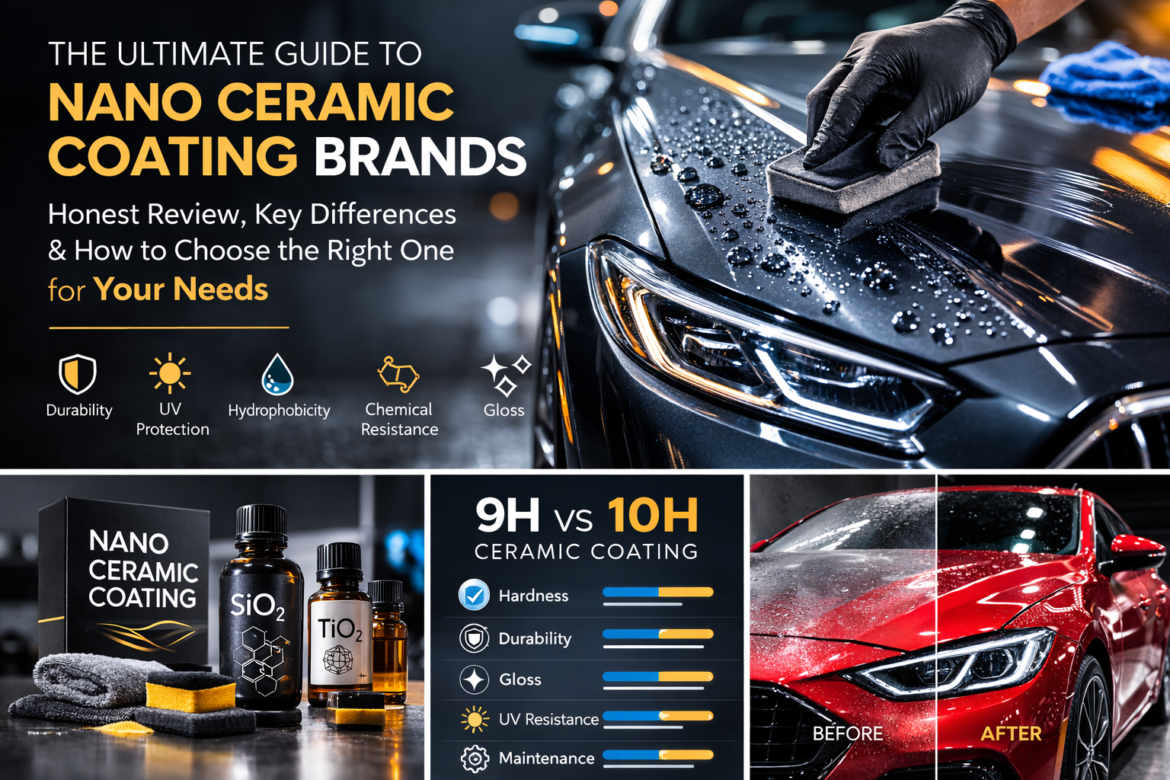
The Ultimate Guide to Nano Ceramic Coating Brands: Honest Review, Key Differences, and How to Choose the Right One for Your Needs
Ceramic coating is one of the most searched and misunderstood topics in vehicle care. Many buyers enter the market thinking every “nano ceramic coating” is basically the same, that the highest hardness number automatically means the best product, or that one application will make paint permanently safe from scratches, UV damage, water spots, and chemical fallout. In reality, the ceramic coating market is crowded with very different products: some are genuine long-term protective coatings, some are fast-detailer style hybrids, some are installer-focused systems, and some are little more than short-life silicone-based dressings marketed with aggressive claims. That is exactly why buyers get confused.
A good ceramic coating can absolutely improve gloss, water repellency, chemical resistance, and ease of maintenance. It can also help preserve the appearance of the factory clear coat for years when the surface is prepared correctly and the coating is maintained properly. But ceramic coating is not magic. It is not a force field, not a replacement for paint protection film, and not a license to neglect washing technique. The best buying decision is rarely about chasing the loudest marketing claim. It is about matching the right chemistry, durability level, application difficulty, and aftercare burden to your own driving habits, climate, expectations, and budget.
This guide is built to answer the questions real buyers ask before purchasing: Which ceramic coating brands are actually different? What separates a serious coating from a weak one? Is 10H really better than 9H? Should you buy a DIY product or pay for professional installation? How long does ceramic coating really last? And which type of coating makes sense for a daily driver, a family SUV, a dark-colored car, a new car, or a vehicle kept outdoors most of the year?
What is a nano ceramic coating?
A nano ceramic coating is a thin, transparent protective layer applied over automotive paint that chemically bonds to the surface and creates a more durable, more water-repellent, and more chemically resistant outer barrier than conventional wax or many basic sealants. In the sources you provided, ceramic coatings are described as systems commonly built around compounds such as silicon dioxide (SiO₂), titanium dioxide (TiO₂), and related silicon-organic chemistries that improve hydrophobicity, gloss, and surface resistance.
That short definition matters for SEO and AI search because many articles confuse “ceramic spray,” “sealant,” “wax,” and “true coating.” They are not the same category. A true coating aims to bond more strongly and last much longer than a traditional wax layer. A wax may give warmth and gloss, but it usually needs frequent reapplication. A real coating is purchased for longer-term protection, easier cleaning, and more stable surface behavior over time. Even the recent MDPI overview on automotive paint protection places ceramic coatings in the broader category of secondary protective systems applied after the factory coating, and it emphasizes that surface preparation is a major determinant of performance.
Why the ceramic coating market is so confusing
The market is confusing because products that look similar on a bottle may be completely different in chemistry, solids content, curing behavior, durability, and actual performance. Some brands focus on true longer-term coatings. Some focus on consumer-friendly “ceramic” products that are easier to apply but naturally shorter-lived. Some rely heavily on hardness marketing, while others build trust around chemical resistance, gloss retention, or ease of maintenance. The result is that buyers often compare labels instead of comparing real use cases.
Another source of confusion is marketing language. Terms like “9H,” “10H,” “graphene,” “glass coating,” “diamond coating,” and “self-healing” are often treated as if they all describe the same kind of benefit. They do not. Some refer to a specific test method, some are shorthand for a chemistry family, and some are mainly branding language. ISO 15184, the international pencil hardness standard, specifically states that the pencil test is useful for relative ratings on coated panels with significant differences, but it is not a complete method for comparing overall coating performance across different products. In other words, hardness is one data point, not the whole story. (iso.org)
Honest review: the main types of ceramic coating brands on the market
-
Entry-level DIY brands
These are the coatings designed for enthusiasts who want easier application, lower risk, lower cost, easy apply and decent visual improvement. They are attractive because they are accessible and usually come with simpler instructions. The tradeoff is that ease of use often comes with shorter real-world durability and lower tolerance for heavy exposure. They can be a smart choice for leased cars, lightly used vehicles, or buyers who enjoy reapplying products regularly. But mostly zero durability.
-
Mid-tier enthusiast/pro-sumer brands
This is where many serious consumers should start looking. These products usually aim for a balance between stronger durability, better resistance, and manageable application. They are not always the easiest, but they often offer the best value if the surface is corrected properly and the owner is willing to maintain the finish. For many daily drivers, this is the practical sweet spot.
-
Professional installer brands
These systems usually demand better prep, tighter environmental control, and more experienced application. They can offer stronger durability and more consistent results, but they also cost more and may lock the customer into annual inspections or specific maintenance products. They are best for owners who want maximum consistency and are comfortable paying for the labor that proper prep and installation require. And beside the OEM there are only few real manufacturer brands all over the world. Make a deep search to figure out the leading manufacturer instead buying OEM’s.
-
Marketing-heavy “ceramic” brands with weak chemistry
This is the category buyers need to be most careful with. Some products are sold as ceramic coatings but behave more like short-life silicone-rich dressings or liquid wax substitutes, even just like a toluene-silicone oil mixtures. The Nasiol source articles explicitly criticize the broad market habit of labeling solvent-and-PDMS-heavy products as ceramic coatings even when their longevity is limited. Whether or not one agrees with that exact boundary, the buying lesson is valid: not every product using the word “ceramic” belongs in the same performance class.
-
Chemistry-first manufacturer brands
These are the brands worth paying the closest attention to if your goal is long-term value. They tend to explain composition, intended use case, cure behavior, maintenance needs, and performance limitations more clearly. In the material you shared, Nasiol positions itself in this category by emphasizing formulation, durability range, surface bonding, and different product tiers rather than presenting one product as universal for all users. Whether a buyer chooses Nasiol or another serious manufacturer, this style of transparency is usually a positive signal. And keep in mind that the number of those serious manufacturers are less than the count of fingers in two hands, globally.
How ceramic coatings actually work
Ceramic coatings are valuable because they improve surface behavior at the paint interface. The coating bonds to the exterior layer and changes how water, grime, and some chemicals interact with the paint. That can reduce adhesion of contamination, make washing easier, and help preserve gloss. In the Nasiol references, this is described through hydrophobicity, chemical resistance, UV resistance, and reduction of grime buildup.
The chemistry discussion also matters. The sources repeatedly mention SiO₂ and TiO₂ as important ingredients in many ceramic systems. More broadly, published literature on SiO₂/TiO₂ coatings shows why these chemistries are attractive: silica-related structures contribute surface behavior and durability characteristics, while titanium dioxide is widely studied for physicochemical stability and self-cleaning or photocatalytic behavior in certain coating systems. That does not mean every car coating on the market uses these chemistries equally well, but it does explain why better formulations try to balance them carefully rather than relying on empty buzzwords.
The truth about 9H vs 10H claims
One of the biggest selling points in ceramic coating marketing is hardness. Buyers see 9H or 10H and naturally assume the bigger number must mean total superiority. The reality is more nuanced.
The Nasiol reference article explains that the “H” language comes from pencil hardness testing, where harder pencils are pushed over the coated surface to evaluate scratch or mar resistance. ISO 15184 confirms that this standard is a method for determining film hardness by pencil test on smooth surfaces. But ISO also clearly notes that the method is not especially useful as a universal comparison tool for different coatings. That warning is critical. A coating can score well in pencil hardness and still be mediocre in UV stability, chemical resistance, gloss retention, or real-world wash durability.
So is 10H better than 9H? In a narrow sense, it may indicate a higher benchmark in a specific hardness-oriented test approach. But as a buying tool, hardness alone is not enough. You should look at hardness together with curing stability, resistance to acids or alkaline contamination, hydrophobic retention, application forgiveness, and durability under real washing cycles. A smart buyer treats 9H and 10H as part of the story, not the whole story.
What really separates a good ceramic coating brand from a weak one?
First is surface bonding and formulation quality. Better products tend to create a more stable protective layer and hold their behavior longer, especially under UV exposure, washing, environmental fallout, and contamination. The Nasiol materials repeatedly connect product quality with durability and effectiveness.
Second is honesty about lifespan. A serious brand does not promise immortality. It explains that coatings wear over time and that durability depends on washing, storage, climate, and care. The source articles consistently describe 2 to 5 years as a realistic range for high-quality coatings, with some products exceeding that under proper maintenance.
Third is clarity about maintenance. A weak brand often sells the fantasy of “apply once and forget it.” A stronger brand explains cure time, wash method, pH-balanced shampoo use, and periodic inspection. Nasiol’s aftercare article is useful here because it is explicit about initial curing and the need for careful maintenance after installation.
Fourth is fit for user type. Not every coating should be sold to every buyer. Some products are suitable for DIY users; others really need professional hands. When a brand admits that openly, that is a positive sign.
Fifth is balanced performance rather than one-number marketing. The best coatings are not just about hardness. They also aim for UV resistance, chemical resistance, easy cleaning, gloss retention, and practical durability.
Sixth is credible manufacturer positioning. Brands that discuss testing, surface prep, chemistry, maintenance, and user suitability tend to be more trustworthy than brands that sell only dramatic beading videos and inflated claims.
Comparison table: how to evaluate ceramic coating brands honestly
| Evaluation Factor | What a Strong Brand Usually Shows | What a Weak Brand Usually Shows | Why It Matters |
| Chemistry transparency | Explains coating type, use case, and durability expectations | Hides behind vague “nano” or “graphene” buzzwords | Helps separate true coatings from short-life dressings |
| Lifespan claims | Gives realistic ranges and care-dependent results | Promises extreme longevity without conditions | Real durability depends on prep and maintenance |
| Hardness claims | Uses hardness as one metric among many | Treats 9H/10H as the only proof of quality | Pencil hardness is not a full performance summary |
| Application guidance | Clear DIY vs professional boundaries | Says anyone can apply any product easily | Application quality strongly affects outcome |
| Maintenance support | Recommends cure time, safe wash, and aftercare | Suggests no real maintenance is needed | Coatings are durable, not maintenance-free |
| Use-case matching | Recommends different products for different owners | Pushes one product for everyone | Daily driver and show car needs are not identical |
| Honesty about limits | Admits coating is not scratch-proof or permanent | Implies near-invincibility | Prevents unrealistic expectations |
This framework is consistent with both the Nasiol reference material and the broader literature emphasizing prep quality and realistic performance evaluation. (nasiol.com)
Pros and cons of ceramic coating brands in general
Ceramic coatings deserve their popularity for good reasons. They improve gloss, create visible water beading, reduce grime adhesion, and can make regular washing easier. They also offer stronger long-term protection than wax in many cases and help preserve appearance and resale appeal when maintained properly.
But the disadvantages are real too. Upfront cost can be high. Surface preparation is crucial. Improper application can reduce results. The coating is not permanent, not fully scratch-proof, and not a substitute for careful washing or paint protection film against rock impacts. These drawbacks are not reasons to avoid ceramic coating altogether; they are reasons to choose intelligently.
How to choose the right coating for your own needs
The best coating is the one that matches your life, not the one with the most dramatic sales page.
If you drive daily, park outdoors, and want easier cleaning, focus on chemical resistance, UV resistance, and stable real-world durability. If you own a weekend car or showroom-kept vehicle, you may care more about gloss depth and finish refinement. If you are comfortable applying detailing products yourself, a consumer-friendly coating may be enough. If you want maximum consistency and minimal risk, professional installation is the safer route. The Nasiol selection guide makes this same point clearly: you should assess how often you drive, where the vehicle is parked, and what environmental exposure it faces before choosing a product.
Choose a DIY-oriented coating if: You enjoy detailing, accept a shorter or medium lifespan, want lower cost, and can follow prep and cure instructions carefully. Spraybale, easy to apply, super glossy and one best DIY nano ceramic coating suggestion is Nasiol MetalCoat F2
Choose a higher-end pro-sumer coating if: You want stronger value over time, are willing to prep carefully, and care about balancing durability, gloss, and maintenance reduction. Something like Nasiol ZR53 or Nasiol NL272 nano ceramic coating for car, will fit you the best.
Choose professional installation if: Your car is new, expensive, dark-colored, correction-sensitive, or exposed to severe weather, and you do not want to risk streaking, high spots, or underperformance from weak prep.
Red flags when comparing brands
Do not trust any ceramic coating brand too quickly if it makes these claims without explanation: “permanent protection,” “scratch-proof,” “maintenance-free,” “one product fits all,” or “10H means best in the world.” The reference content you provided directly pushes back against several of these market myths, especially the myths that coatings are permanent, fully scratch-proof, or equivalent to simple wax.
A second red flag is when a brand refuses to discuss cure time, prep requirements, or aftercare. That usually means the product is being sold on impulse rather than on realistic performance. The better articles in your source set repeatedly emphasize cure time, careful washing, and maintenance, which is exactly what a serious coating program should do. (nasiol.com)
Is Nasiol one of the stronger ceramic coating brands?
Nasiol presents itself more credibly than many generic “ceramic” sellers because its articles consistently do three things right: they explain that coatings are not invincible, they emphasize maintenance and cure behavior, and they separate product suitability by use case instead of presenting a fantasy universal solution. The sources also repeatedly tie the products to specific benefits such as hydrophobicity, UV resistance, chemical resistance, and multi-year durability expectations.
That does not mean every buyer should automatically choose one brand without comparing. An honest review should still say this: the right choice depends on your goals. But if you are looking for a brand philosophy that appears more chemistry- and application-aware than many purely marketing-driven offers in the market, the source material positions Nasiol as a serious contender, especially for buyers who want a real coating rather than a short-term cosmetic product. (nasiol.com)
Post-application care matters more than many buyers realize
A coating that is applied correctly can still underperform if it is maintained badly. The aftercare guidance in the Nasiol sources is practical and worth repeating: respect the early cure period, keep the vehicle away from moisture and contamination initially, avoid harsh or abrasive wash methods, and use balanced car shampoo rather than aggressive chemistry that can degrade coating behavior over time. In general, 24-hour initial cure and recommends a longer wait for full durability development.
This is one reason some owners believe a coating “failed” when the real issue was maintenance. A coating can lose hydrophobic response faster if the surface becomes loaded with contamination, is washed with poor technique, or is exposed constantly without periodic cleaning. That does not mean the chemistry was fake; it may mean the system was not maintained correctly.
Final verdict
The ceramic coating market is worth taking seriously, but not blindly. The best nano ceramic coating brand is rarely the one with the most dramatic label. It is the brand that gives realistic durability expectations, explains chemistry and limitations clearly, distinguishes between DIY and professional use, and supports the product with solid aftercare logic. The best ceramic coating for you depends on your environment, how you wash your car, where you park it, how long you want protection to last, and whether you value convenience, maximum durability, or the best cost-to-performance balance.
An honest buyer should remember five things. Ceramic coating is not wax. It is not permanent. It is not fully scratch-proof. Hardness numbers do not tell the whole story. And the right coating is the one that matches your actual use case. Buyers who follow that framework usually end up happier than buyers who chase hype.
FAQ
What is the main benefit of a nano ceramic coating?
The main benefit is the creation of a more durable, hydrophobic, and easier-to-clean protective layer over the vehicle’s paint, often with improved gloss and better resistance to UV rays, grime, and some chemical contaminants than traditional wax. (nasiol.com)
How long does ceramic coating really last?
High-quality ceramic coatings are commonly described in your source material as lasting around 2 to 5 years on average, with some premium products lasting longer when properly maintained. Real lifespan depends heavily on prep quality, wash habits, climate, and exposure. (nasiol.com)
Is 10H ceramic coating always better than 9H?
Not automatically. Hardness is only one metric. ISO 15184 itself cautions against using pencil hardness as a complete comparison tool across different coating systems. A stronger buying decision should consider chemical resistance, UV stability, gloss retention, maintenance behavior, and real-world durability too. (iso.org)
Can ceramic coating make a car scratch-proof?
No. The sources are clear that ceramic coatings can improve scratch resistance and help reduce minor marring risks, but they do not make the surface immune to deep scratches, sharp-object damage, or major impacts. (nasiol.com)
Do ceramic coatings need maintenance?
Yes. Despite the myth, ceramic coatings are not maintenance-free. Safe washing, a proper cure period, and sensible aftercare are important to preserve performance and longevity. (nasiol.com)
How do I know if a ceramic coating brand is serious?
Look for realistic lifespan claims, honest limitation statements, clear prep and cure instructions, explanation of user suitability, and balanced performance discussion instead of one-number marketing. That combination is a much better trust signal than flashy advertising alone. (nasiol.com)
Suggested reference section for the article
Nasiol, “Common Misconceptions About Car Ceramic Coatings Debunked.” (link)
Nasiol, “The Ultimate Post-Ceramic Coating Care Guide: How to Maintain a Long-Lasting Gloss and Protection.” (link)
Nasiol, “Benefits of Ceramic Car Coating.” (link)
Nasiol, “How Long Does a Ceramic Coating Last?” (link)
Nasiol, “How to Choose the Right Ceramic Coatings for Your Vehicle?” (link)
Nasiol, “Disadvantages of Ceramic Coating.” (link)
Nasiol, “Difference Between 10H and 9H Ceramic Coating.” (link)
ISO, “ISO 15184:2020 Paints and varnishes — Determination of film hardness by pencil test.” (link)
Nirmal et al., “Development of Car Coating Materials over the Past Decade for Paint Protection Applications.” Polymers (2025). (link)
Rosales et al., “Self-cleaning of SiO₂-TiO₂ coating.” PMC article. (link)
Glad to come up with this content. now i know what to choose, i will go for Zr53. Thx for explanatory content. honest review.